If I Upload a Video to a Website Can People Identify Me Using Exif Data?
Metadata contained in images and other files can requite away a lot more than data than the average user might recall. Past tricking a target into sending a photo containing GPS coordinates and additional data, a hacker tin can acquire where a mark lives or works simply past extracting the Exif data hidden inside the prototype file.
For hackers or OSINT researchers gathering digital prove, photos can be a rich source of information. Besides what'south visible in the picture itself, metadata near when and where the photo was taken tin can also exist recoverable. This data can include the device the photo was taken on, the geolocation of the image, and other unique characteristics that can fingerprint an paradigm every bit haven been taken by the same person or device.
- Don't Miss: How to Hide Secret Data Inside an Prototype or Audio File in Seconds
Metadata, or the information that describes files like images or videos, is useful during reconnaissance to investigators considering it's often overlooked by otherwise careful targets. If people don't know what kind of data can be retained in a detail file format, they won't know if they're putting themselves at risk by making a specific file public. While many social media platforms have largely eliminated this problem by stripping out metadata from files, there are still many images online with this information left entirely intact.
Exif Data in Images
Exchangeable paradigm file format information, or Exif information, is information that accompanies image files and offers many fields that can be populated or left bare. The information is used by programs to understand improve what is contained inside the file to aid in sorting and other functions. Available information fields in Exif are often written to by the device that took the image at the time information technology was shot but tin as well be left past processing programs similar Photoshop.
- Don't Miss: Conduct OSINT Recon on a Target Domain with Raccoon Scanner
Because we can often identify the model of camera used, the settings used, and supplementary information similar the owner of the software that made Photoshop changes, it'south possible to identify images that came from the same source. The more Exif fields are filled out past the device that shot the image or software that processed it, the easier it is to track other files fabricated by the same process.
The total list of fields that are supported past the Exif standard is quite extensive. Aside from manufacturer-specific data, fields like the possessor'due south proper name and address can be populated past paradigm processing software without the author knowing each prototype they produce contains this information.
What Yous'll Need
While an older Null Byte article on Exif information features a dated Windows-just tool that still works, we'll focus simply on a program that's pre-installed on Kali Linux, as well as a few tools that'll work on any system right from a spider web browser.
- Old Tool: Extracting Metadata from Image Files with ExifReader on Windows
Selection 1: Use the Exif Control Line Tool
To start, we'll be using the "exif" tool that comes pre-installed in Kali Linux. This program is the command line front end-end to "libexif," and it only works on JPG file types. To see the options available to us, we can run the exif --help command to list the included options.
If y'all receive an fault, or if you're using another OS similar Debian or Ubuntu, open a new terminal window and type apt install exif to install the plan and whatsoever needed dependencies. Similarly, you can install this tool by typing mash install exif on a MacOS device. Then, try exif --aid again.
You can use man exif to view even more than information about the tool.
~$ exif --help Usage: exif [OPTION...] file -v, --version Display software version -i, --ids Show IDs instead of tag names -t, --tag=tag Select tag --ifd=IFD Select IFD -l, --list-tags List all EXIF tags -|, --bear witness-mnote Show contents of tag MakerNote --remove Remove tag or ifd -s, --evidence-description Show description of tag -east, --excerpt-thumbnail Extract thumbnail -r, --remove-thumbnail Remove thumbnail -n, --insert-thumbnail=FILE Insert FILE as thumbnail --no-fixup Do non set existing tags in files -o, --output=FILE Write information to FILE --gear up-value=STRING Value of tag -c, --create-exif Create EXIF data if not existing -one thousand, --machine-readable Output in a machine-readable (tab delimited) format -w, --width=WIDTH Width of output -x, --xml-output Output in a XML format -d, --debug Show debugging letters Help options: -?, --help Testify this help message --usage Brandish brief usage message While all of the options is a lot to process, the about straightforward application of this tool is to type exif and then the path to the file you want to inspect. Beneath, a photograph that'southward been processed in Photoshop retains data about the software that modified it, the computer it was modified on, and the camera it was taken on. If yous get a "corrupt data" mistake, there may be no metadata in the file or yous're scanning a file that's not a JPG.
-$ exif /Users/skickar/Downloads/Vacaynev-28.jpg EXIF tags in '/Users/skickar/Downloads/Vacaynev-28.jpg' ('Intel' byte order): --------------------+---------------------------------------------------------- Tag |Value --------------------+---------------------------------------------------------- Manufacturer |Catechism Model |Canon EOS 60D X-Resolution |300 Y-Resolution |300 Resolution Unit |Inch Software |Adobe Photoshop Lightroom v.six (Macintosh) Date and Time |2016:xi:25 17:45:xi Pinch |JPEG compression 10-Resolution |72 Y-Resolution |72 Resolution Unit |Inch Exposure Time |one/100 sec. F-Number |f/4.0 Exposure Program |Manual ISO Speed Ratings |640 Exif Version |Exif Version 2.3 Appointment and Time (Origi|2016:11:25 02:56:54 Date and Time (Digit|2016:11:25 02:56:54 Shutter Speed |6.64 EV (1/99 sec.) Aperture |4.00 EV (f/4.0) Exposure Bias |0.00 EV Maximum Aperture Val|3.00 EV (f/2.8) Metering Fashion |Pattern Flash |Flash did not fire, compulsory flash style Focal Length |17.0 mm Sub-second Time (Ori|00 Sub-second Time (Dig|00 Color Infinite |sRGB Focal Plane X-Resolu|5728.177 Focal Plane Y-Resolu|5808.403 Focal Plane Resoluti|Inch Custom Rendered |Normal process Exposure Style |Manual exposure White Residual |Automobile white balance Scene Capture Blazon |Standard FlashPixVersion |FlashPix Version 1.0 --------------------+---------------------------------------------------------- EXIF information contains a thumbnail (16091 bytes). Data can also include geolocation data, as exact coordinates, which is supplied by the device that took the photo. If the photo was taken on a telephone, there is a much higher take a chance that it includes geotags.
Every bit information technology is in the output in a higher place, we've learned that the person who created this file is using a Canon EOS 60D camera, has a lens with a focal length of 17.0 mm, worked on the file in Lightroom, and uses a Mac calculator. That's a lot from a simple prototype file!
- Don't Miss: Stop Your iPhone Photos from Broadcasting Your Location to Others
Choice 2: Apply Jeffrey'south Image Metadata Viewer Spider web App
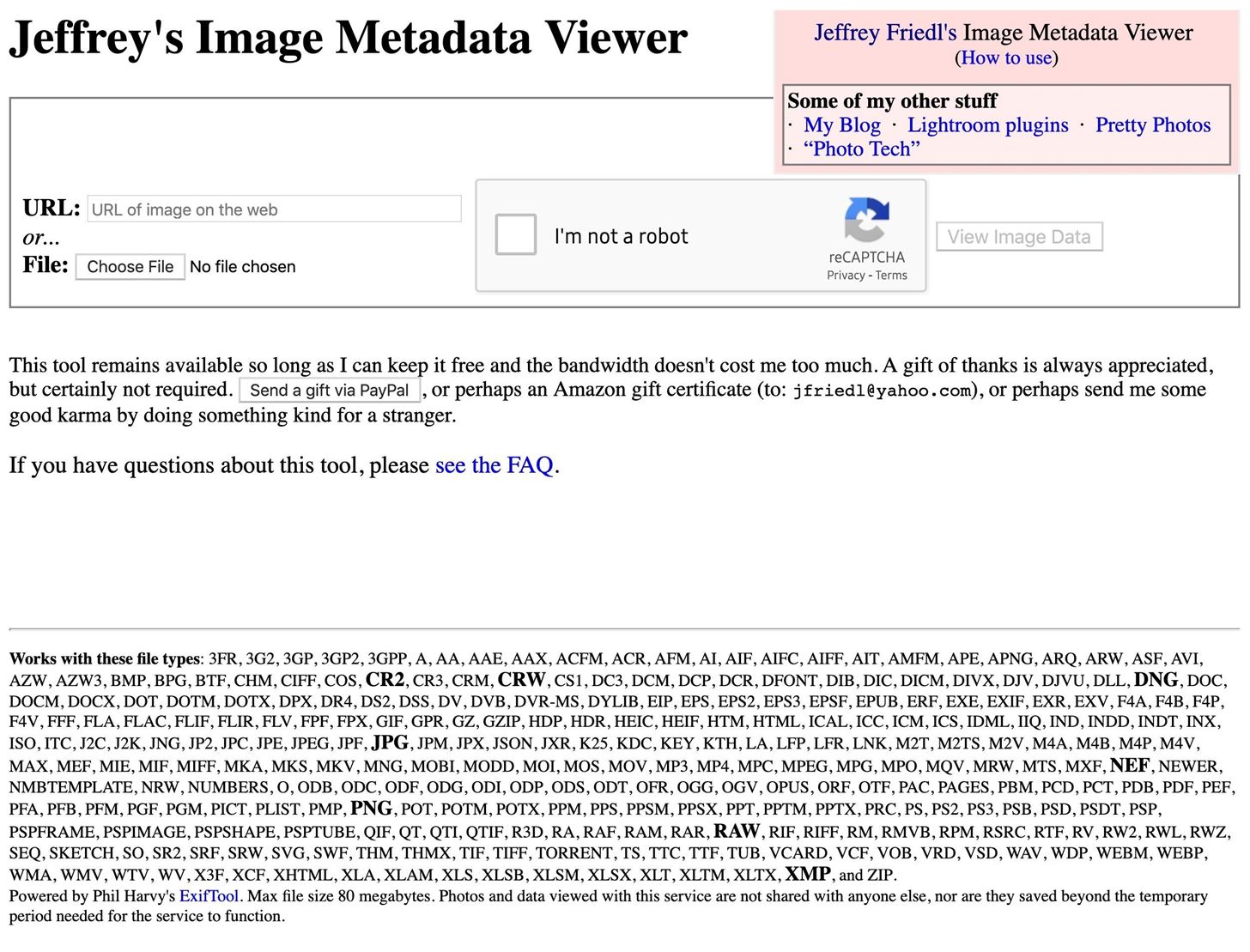
If you're using a browser, there are two smashing free websites to extract Exif data. First, allow'due south beginning with Jeffrey Friedl'southward Image Metadata Viewer over at exif.regex.info. The site does not utilise HTTPS, unfortunately. If you don't mind that, you can encounter the unproblematic design is easy to use and supports a vast multifariousness of formats, unlike the command line tool which only works with JPG files. Then you tin can scan RAW images files like CR2 and DNG, PNG, and TIFF, to proper name a few.
Upload a file or add its public URL, check the CAPTCHA, and hitting "View Image Data."
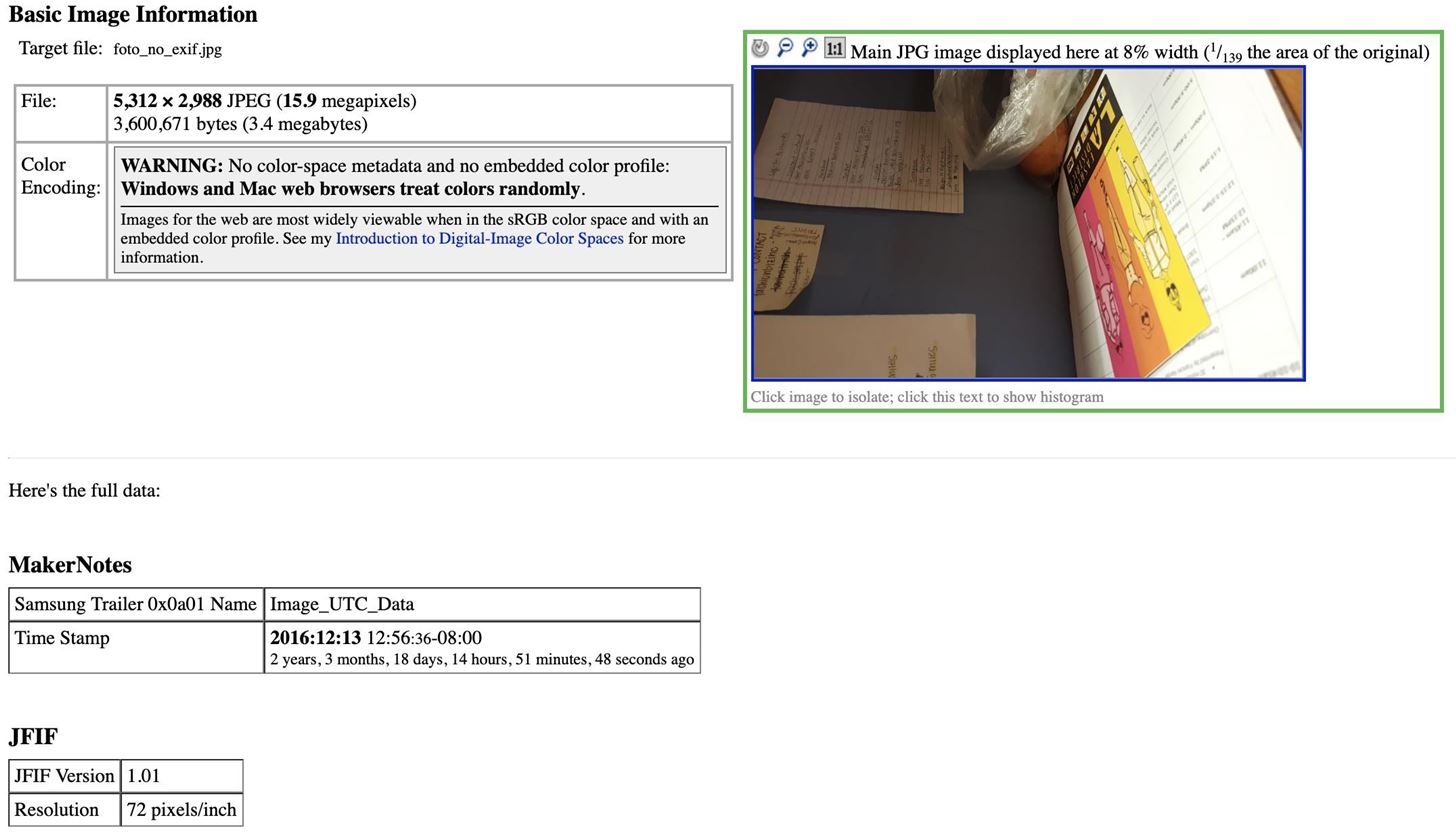
Once you lot scan a file, y'all should see a decent amount of information if it came from a smartphone. In my example below, a photo that's over two years old contained a GPS location.
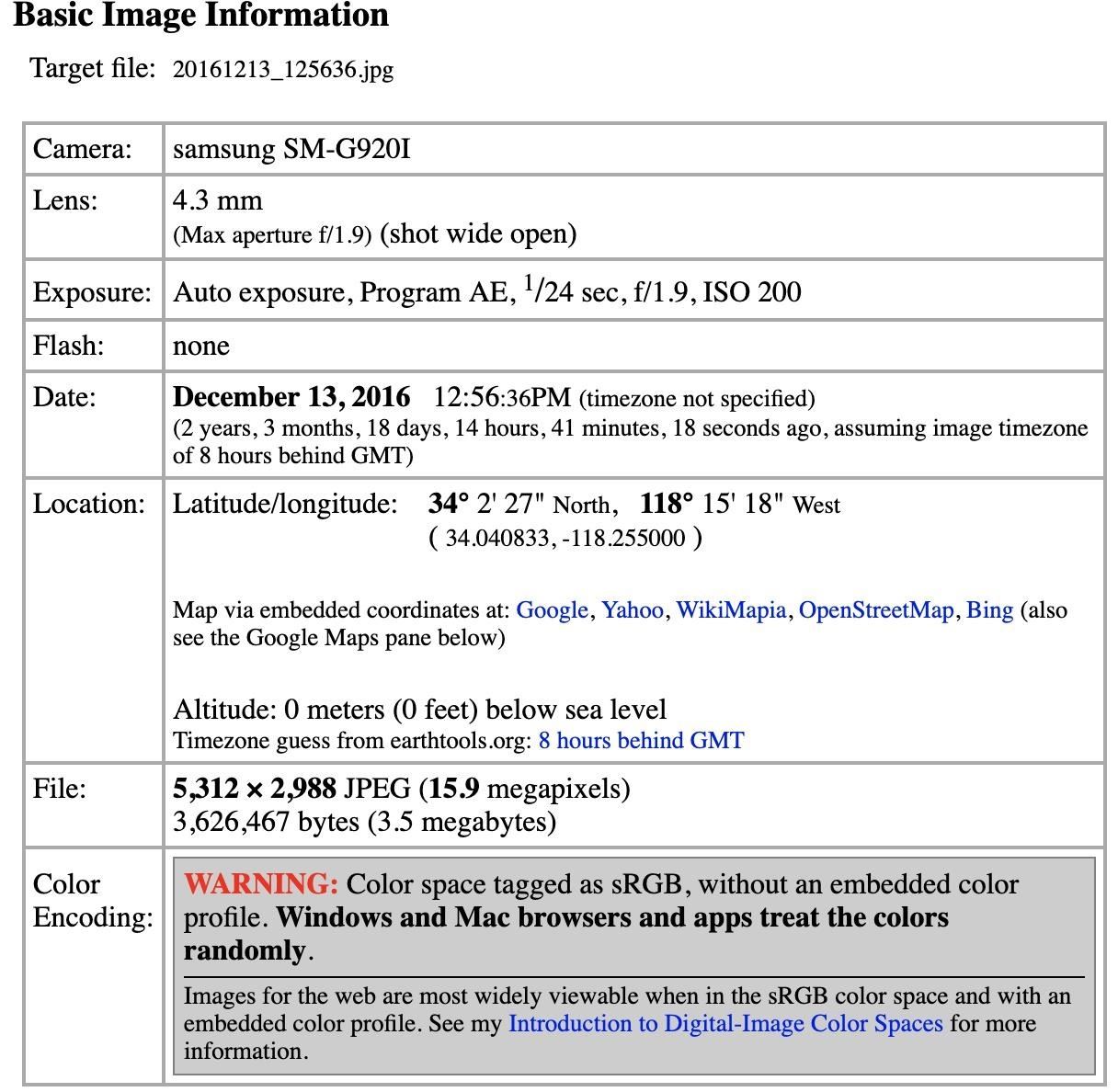
The actual amount of data captured takes up several pages and is quite extensive.
EXIF Make samsung Camera Model Name SM-G920I Software G920IDVS3EPK1 Change Date 2016:12:13 12:56:36 ii years, three months, 18 days, fifteen hours, 41 minutes, 18 seconds ago Y Cb Cr Positioning Centered Exposure Time one/24 F Number 1.90 Exposure Program Program AE ISO 200 Exif Version 0220 Date/Time Original 2016:12:13 12:56:36 ii years, three months, 18 days, 15 hours, 41 minutes, 18 seconds agone Create Date 2016:12:thirteen 12:56:36 2 years, iii months, 18 days, 15 hours, 41 minutes, 18 seconds ago Shutter Speed Value 1/24 Aperture Value one.90 Brightness Value 0.27 Exposure Bounty 0 Max Discontinuity Value 1.nine Metering Mode Spot Wink No Flash Focal Length 4.3 mm Image Size five,312 × 2,988 Maker Notation Unknown (98 bytes binary data) User Comment Flashpix Version 0100 Color Space sRGB Exposure Mode Auto White Balance Motorcar Focal Length In 35mm Format 28 mm Scene Capture Type Standard Epitome Unique ID A16LLIC08SM A16LLIL02GM GPS Version ID 2.ii.0.0 GPS Latitude Ref N GPS Breadth 34.040833 degrees GPS Longitude Ref Due west GPS Longitude 118.255000 degrees GPS Altitude Ref Below Ocean Level GPS Altitude 0 m GPS Time Stamp 20:56:27 GPS Date Stamp 2016:12:13 2 years, 3 months, 19 days, 4 hours, 37 minutes, 54 seconds ago Epitome Width 512 Image Height 288 Compression JPEG (erstwhile-fashion) Orientation Rotate 90 CW Resolution 72 pixels/inch Thumbnail Length 11,484 Thumbnail Epitome (11,484 bytes binary information) MakerNotes Unknown 0x0001 0,100 Unknown 0x0002 73,728 Unknown 0x000c 0 Unknown 0x0010 undef Unknown 0x0040 0 Unknown 0x0050 ane Unknown 0x0100 0 Samsung Trailer 0x0a01 Proper name Image_UTC_Data Time Stamp 2016:12:13 12:56:36-08:00 two years, 3 months, xviii days, 14 hours, 41 minutes, xviii seconds ago File — basic information derived from the file. File Type JPEG MIME Blazon image/jpeg Exif Byte Society Picayune-endian (Intel, II) Encoding Process Baseline DCT, Huffman coding Bits Per Sample 8 Color Components iii File Size 3.5 MB File Type Extension jpg Image Size 5,312 × 2,988 Y Cb Cr Sub Sampling YCbCr4:ii:2 (two i) Composite This block of data is computed based upon other items. Some of it may exist wildly incorrect, especially if the image has been resized. GPS Breadth 34.040833 degrees N GPS Longitude 118.255000 degrees W GPS Distance 0 grand Above Bounding main Level Discontinuity one.xc GPS Engagement/Fourth dimension 2016:12:xiii 20:56:27Z 2 years, three months, 18 days, fourteen hours, 41 minutes, 27 seconds ago GPS Position 34.040833 degrees N, 118.255000 degrees Westward Megapixels 15.9 Shutter Speed 1/24 Light Value 5.four Calibration Cistron To 35 mm Equivalent 6.v Circle Of Confusion 0.005 mm Field Of View 65.5 deg Focal Length four.three mm (35 mm equivalent: 28.0 mm) Hyperfocal Distance 2.11 one thousand Selection 3: Use Ver Exif's Spider web App
Our second website, Ver Exif at verexif.com, spits out all of the Exif data after a scan, but it besides comes with an option to strip metadata out of images. Removing the metadata is useful if you want to make sure an image you're sending doesn't comprise data you didn't intend to transport.
- Don't Miss: How to Hide Data in Audio Files Like Mr. Robot
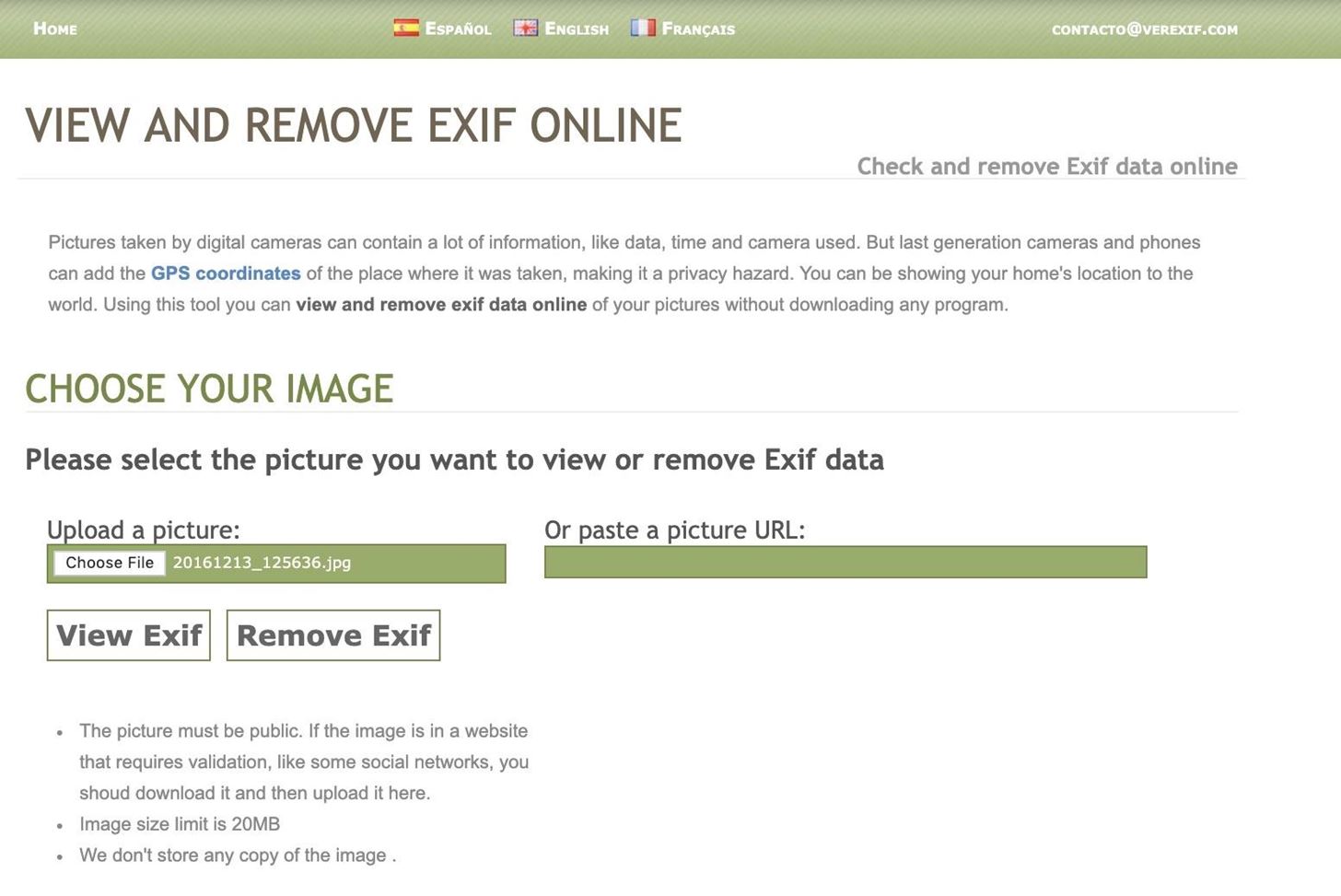
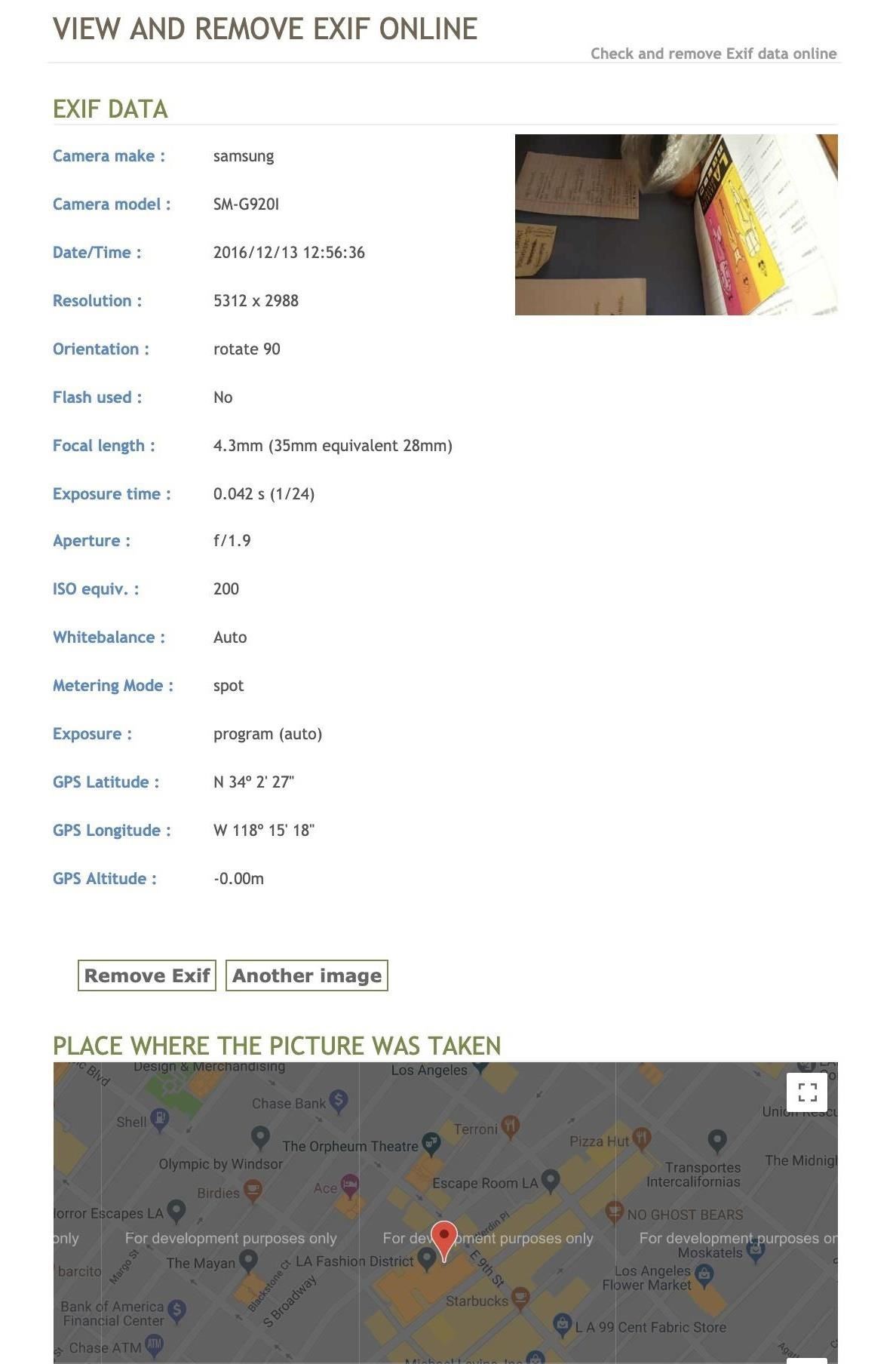
To view Exif data, upload a file or add its public URL, then hitting "View Exif." In my example, passing the same photo into this website, the output is much less, but information technology generates a handy map of where the photo was taken. The data is accurate, merely not equally big of a data dump as the Image Metadata Viewer web app.
Interestingly, subsequently I passed the examination photo through the "Remove Exif" data option, I uploaded information technology to the first website to meet if the metadata was truly removed. It turns out I can nevertheless tell it was taken on a Samsung device, so I don't recommend using this tool to strip metadata from your photos.
Selection iv: Apply the EXIF Viewer Chrome Extension
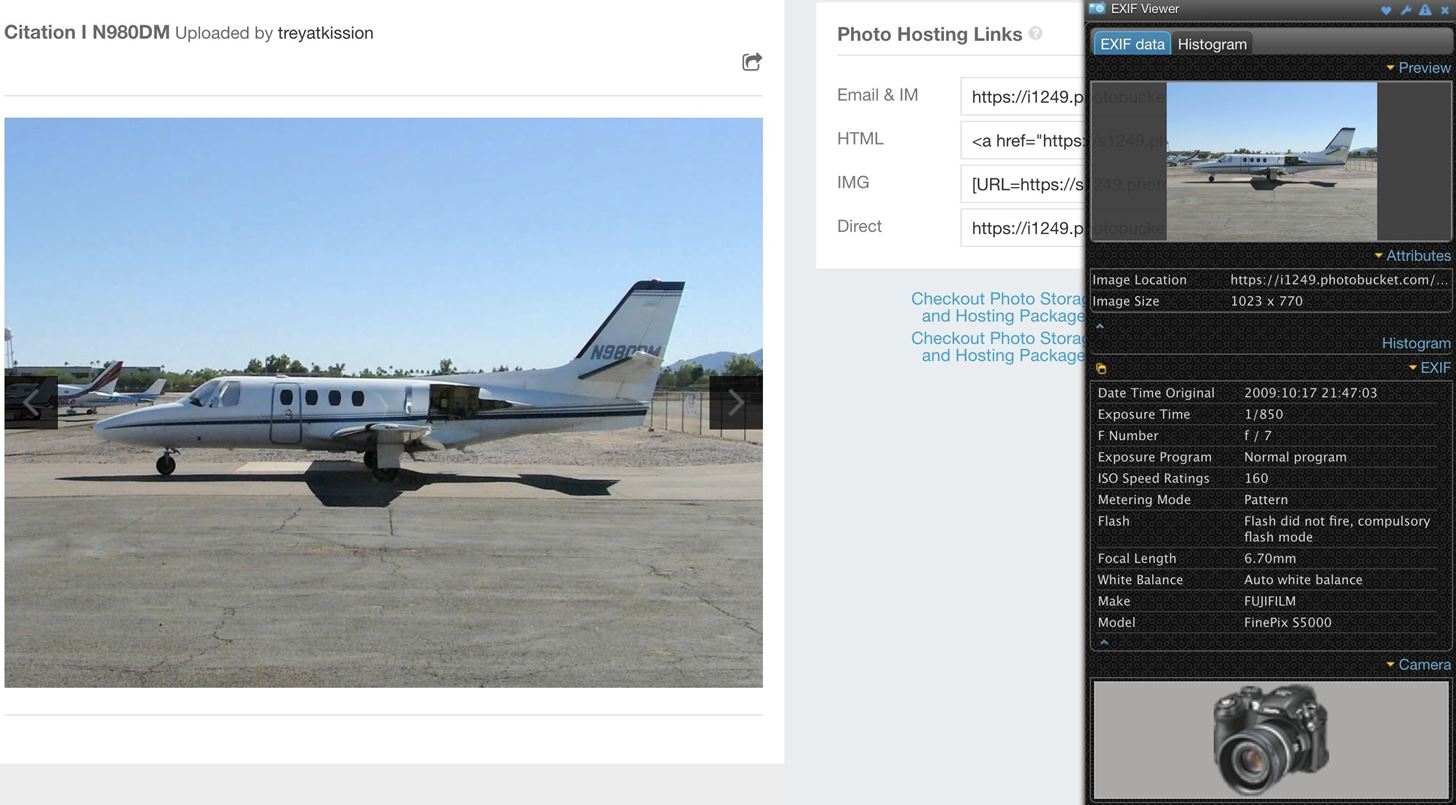
In Google Chrome, yous can install the EXIF Viewer extension, which volition let you pull up the Exif data from whatsoever photograph you load into the browser.
Using browser add-ons to extract Exif data is even simpler than using a web-based tool. Later installing and enabling the plug-in, we can right-click any epitome in the browser and select "Show EXIF information" to reveal any data the image contains.
To test this out, I found a random image on a photograph-sharing website and looked through the metadata provided past EXIF Viewer to observe the type of camera that was used to take it.
Option v: Use the Exif Viewer Firefox Improver
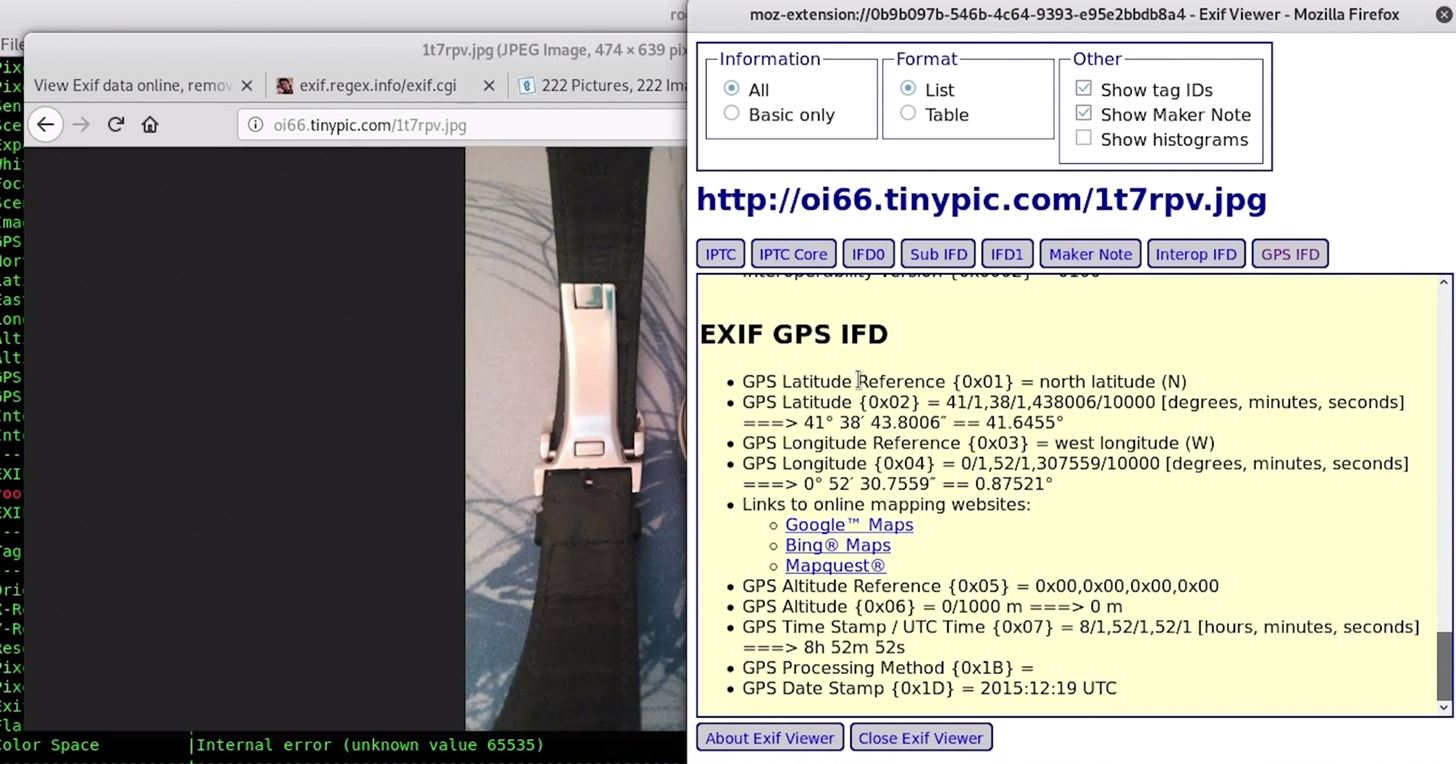
You could as well install the Exif Viewer add-on for Firefox, developed by Alan Raskin, which allows similar functionality as the Chrome extension higher up. Subsequently installing and enabling the add together-on, correct-click on an image in your browser, then click on "Exif Viewer."
A pop-up window appears, where there's a slew of metadata to sort through. You lot tin can see the link to the image; in the GPS section y'all get links to open up the location on Google Maps, Bing Maps, and Mapquest; and all of the other helpful information in the Exif information.
In general, browser extensions are a great mode to tackle extracting Exif data, because y'all can too open photos in a browser window and utilize an extension to read the data inside.
Metadata Reveals the Story Behind a Photo
While a photo may yield valuable data, the existent value may exist in what's encoded in the metadata. Accessing this data is easier than e'er, and then it's essential to be aware of what information you may be giving away when you send a photo.
While many social media platforms and photo-hosting services do you the favor of stripping out this data, not all do. It's important to make sure you're not leaking this data if y'all don't intend to, and these tools can apace help yous identify any ways you might be leaking your location or other individual data in photos you want to share online. Most importantly, make certain to disable geo-encoding on your phone if you don't want GPS coordinates burned into every image you take.
I hope you enjoyed this guide to extracting subconscious metadata from image files! If you have any questions almost this tutorial on image OSINT or you have a comment, ask below or feel free to achieve me on Twitter @KodyKinzie.
Want to start making coin as a white chapeau hacker? Leap-start your hacking career with our 2020 Premium Upstanding Hacking Certification Training Bundle from the new Zero Byte Shop and get over 60 hours of preparation from cybersecurity professionals.
Buy Now (90% off) >
Other worthwhile deals to check out:
- 97% off The Ultimate 2021 White Hat Hacker Certification Bundle
- 99% off The 2021 All-in-One Data Scientist Mega Bundle
- 98% off The 2021 Premium Learn To Code Certification Bundle
- 62% off MindMaster Mind Mapping Software: Perpetual License
Source: https://null-byte.wonderhowto.com/how-to/obtain-valuable-data-from-images-using-exif-extractors-0195471/
0 Response to "If I Upload a Video to a Website Can People Identify Me Using Exif Data?"
Post a Comment